

minimal-ish
minimal-ish is where I think out loud about simplicity, space and what actually matters. I explore a life of “less, but better,” share what I’m learning in real time and embrace simplicity without the pressure of perfection.
The Gentle Art of Swedish Death Cleaning
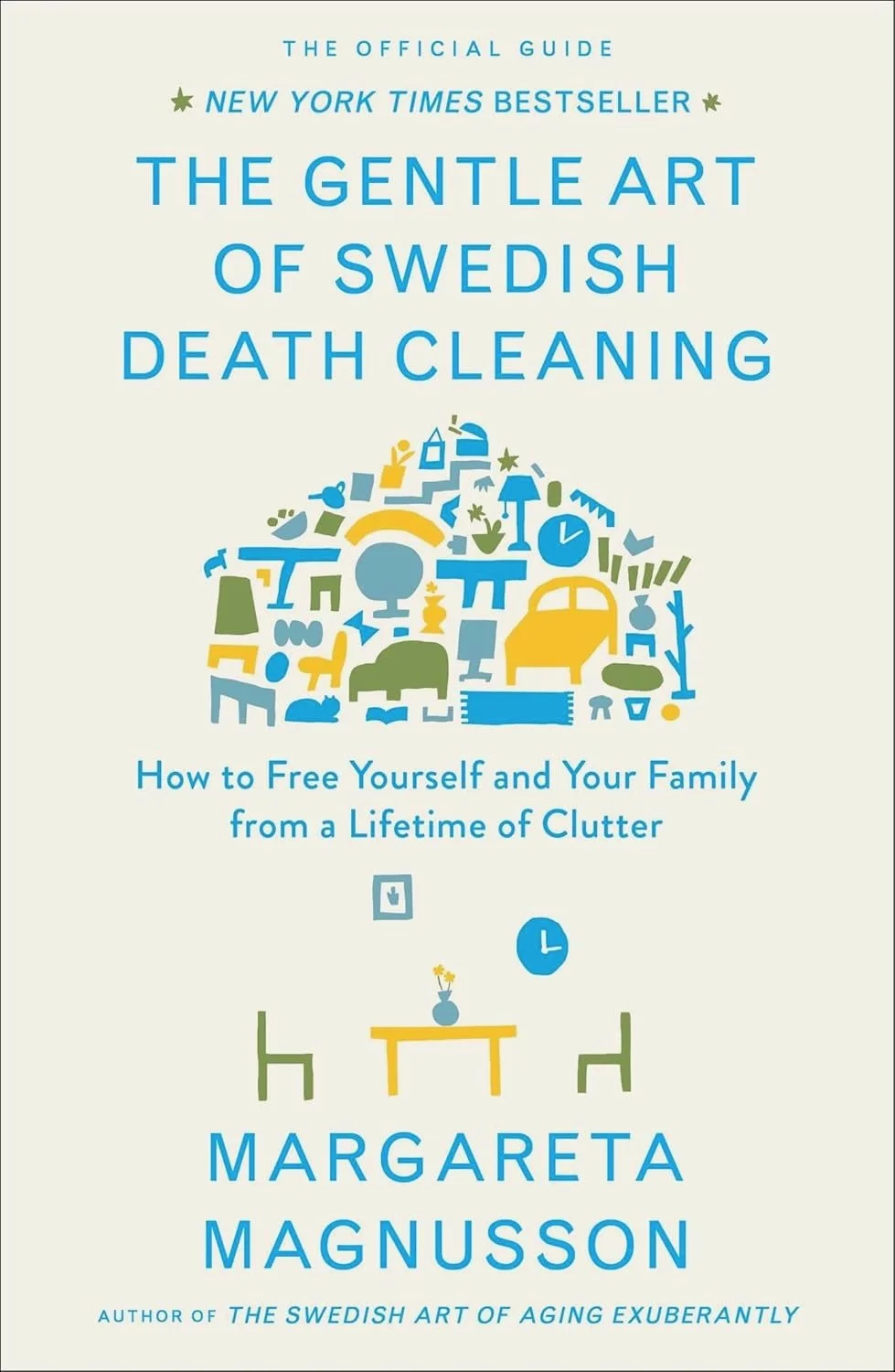
I loved this book for its simplicity, short length and the fact that a woman from an older generation wrote about dealing with your stuff while you still can and making your home nice and orderly before you die (she says it in a nicer way though).
This New York Times best selling book was written by Swedish-born artist Margareta Magnusson who doesn’t give her precise age but instead states that she is now “somewhere between 80 and 100 years old.”
I love that she gives an age range. I feel that at that age the number really doesn’t matter anymore - she hit her 80s and felt like it’s time to share what’s she learned. She actually thinks it’s her responsibility of her old age to tell us about her experiences because she thinks this “death cleaning” philosophy is that important.
I love that the older generation speaks their mind more freely than younger ones because life experience has given them confidence and the mindset that “I’ve lived my life…I’m going to say what I think.” And overall she thinks we all need to get more comfortable with the idea of letting go - and as a professional organizer I couldn’t agree more.
what is death cleaning?
In Sweden there is a kind of decluttering called döstädning, dö meaning “death” and städning meaning “cleaning.” It’s all about clearing out unnecessary belongings at any stage of life…but it’s best to be done before others have to do it for you.
Margareta states the obvious in her book…that “the only thing we know for sure is that we will die one day.” She writes this book because she wants our loved ones’ memories of us to be nice - not awful - and this can be done by dealing with our “stuff” before we die so that our family and friends won’t have to. She encourages us to go through the things in our homes to declutter and mark what should happen with each item that we intentionally leave. While it most obviously applies to older generations dealing with a lifetime of memories and things (a reflection of their lives) - I agree with Margareta that its concept should apply to ALL of us at any stage of life.
While it can be hard for younger generations to talk about death with parents and other family members, dealing with our “things” while everybody is young and able could be really beneficial for both parties (I’m talking about the physical, not just the medical directives and wills or finances which are equally as important if not more so). Sometimes this decluttering is done when your parents downsize or move from your family home but sometimes it either doesn’t get decluttered enough or your parents never leave the family home (and so there’s no real reason to purge). Margareta suggests ways to broach these sensitive conversations and keep the process from becoming overwhelming by recommending how and where to start decluttering.
If you find that you really can’t broach the topic about managing your older loved one’s things, take her advice in what not to do for your loved ones who will be left after you die. When you have to deal with your parent’s home and things, you’ll see how time-consuming and stressful it can be, and costly too if you need to hire home organizers, estate sale services and junk removal companies to aid you in this process (and/or possibly while fighting with siblings and extended family about helping).
These professional services are great and very helpful - but what they can’t address is all of the sentimental decision making that you might find really hard when sorting through a lifetime of things. Knowing your parent’s and other loved one’s wishes up front, and even having encouraged them and helped them declutter before they cannot actually be a part of it, can make the entire process go more smoothly, which during a sad time can be so helpful (and even help avoid future chaos amongst other family members).
Yes, the topic of death is morbid. But, since literally not one of us is going to make it out alive…why not live in a simpler and more organized home in the meantime so that we can focus on more fun and important things? These concepts can and should be applied throughout your younger years so that you learn to accumulate less stuff and make it easier for not only you to live - but for other people to take care of things without you - enabling them to focus on the memory of you and not your things.
quotes and advice i loved
“Some people can’t wrap their heads around death. And these people leave a mess after them. Did they think they were immortal?”
“The difference between death cleaning and just a big cleanup is the amount of time they consume. Death cleaning is not about dusting or mopping up; it is about a permanent form of organization that makes your everyday life run more smoothly.”
“I have death cleaned so many times for others, I’ll be damned if someone else has to death clean after me.”
“Your exhaustion with all of this stuff may appear out of the blue one day…The problem is that you have too much stuff to deal with. It is time to change your way of living. It is never too late to start!”
“Do not ever imagine that anyone will wish - or be able - to schedule time off to take care of what you didn’t bother to take care of yourself. No matter how much they love you, don’t leave this burden to them.”
“…with a little practice and preparation, it will certainly be easier for you to make decisions about how to get rid of things. Trust me, the more time you spend going through your belongings, the easier it will be for you to decide what to keep and what not to.”
“In general, when death cleaning, size really matters. Start with the large items in your home, and finish with the small.”
start somewhere but start now
In the fast paced world we live in today, which Margareta acknowledges in her book, people don’t have the time (and often desire or patience in my opinion) it takes to deal with your things properly after you die. This can cause stress both in terms of time and financially too - so don’t burden others with this sometimes monumental task. Carving out time to streamline your life while you can will help you live more simply while making it easier for others once you are gone.
I hope you read this book because it’s a quick read packed with simple points and practical advice, many of which I’ve outlined above that you can apply today - because as with most things, it really starts with mindset. Get on board with the why behind decluttering and simplifying, then start to take small actions to arrive at your end goal. Small consistent steps add up to big changes which includes big savings in time and stress - and who wouldn’t want that?
Until next time,
P.S. I have Margareta’s other book that I’ll be reading soon (The Swedish Art of Aging Exuberantly) because I definitely want to hear more of this woman’s wisdom and I would love to age as gracefully as possible. That book’s ultimate message is that we should not live in fear of death but rather focus on appreciating beauty, connecting with our loved ones, and enjoying our time together. I can’t wait to read it!
Are You At Capacity?
I think a lot about the concept of “capacity.” The dictionary defines capacity as “the maximum amount that something can contain” or “the amount that something can produce” or “a specified role or position.”
In terms of organizing, I obviously think of capacity constantly - is the designated space in our homes for the various categories of things in it, at capacity? Is it full? Overflowing? Or is it spacious with room to grow and breathe? This can determine the next course of action with how we help you get organized in your home.
On a personal level though, I often wonder if we have the mental and physical bandwidth for the tasks we are responsible for and voluntarily take on. Do we actually have the time, energy or skills to be doing all that we’re doing?
Through my work, I see women - lots of women - who are busy, ambitious women, mothers, caregivers, executives, dreamers, doers…all doing A LOT. Some women handle it with ease, and others, not so much (they’re drowning). Some have lots of help (which is amazing) and some are getting by by the skin of their teeth. I myself can go either way. I can make it look as if I handle it all with ease, and often it is easy because I am a great planner, but every now and again I do break down because I’ve overdone it. I thrive on chaos and coordination and making things happen - not to be busy for the sake of being busy, but because I am multi-passionate and have a full, fun life.
pausing for a reality check
Occasionally I have to give myself a reality check and for a minute (or even a week) analyze everything on my plate. I think about what’s working and what’s not. This typically happens after a particularly stressful few weeks. I’ve only learned to do this after many moments of falling apart - including burning out from juggling corporate work and my personal life many years ago. When I fall apart it’s usually from working too much, feeling overly tired, becoming overstimulated, a lack of cardio, and sometimes being underfed (hello, hangry). It’s overall exhaustion - but usually heavy on the overstimulation - it’s like my brain can no longer make a simple decision because there are just too many to be made.
When I’m near those moments, I now stop and ask myself “am I at capacity right now?” If so, I know without a doubt I cannot take on something else at the moment - whether it’s a request from family, friends, or clients. And if I’m already there, I look at what I can take off my plate, whether it’s indefinitely or just temporarily. If it’s an important task or event and it needs to be prioritized, then I have to pause or cancel something else that’s going on at the time to make room - because like a puzzle, only so many things can fit. Whenever possible, I ask for help so that everything can still get done (if it must).
I’ve learned to be a lot more realistic and give myself a lot more grace. I will actually say out loud “I am not a robot” to remind myself that we don’t exist to just do do do. I’m not trying to be busy for the sake of being busy but 95% of the time I am trying to be productive, and my mental health sometimes suffers for it. When I actually say out loud “I don’t have the capacity for that right now” I immediately feel better. Just saying this gives myself the permission to let that idea go - for now, or for good. Hearing my own words makes me realize I’m full - possibly overflowing - and it’s ok to say no. It doesn’t even feel disappointing - it actually feels empowering.
recognizing your season of life
The other thing I have started recognizing a lot lately is the fact that there are different seasons to our lives. I don’t know why it has taken until my 40s to see this but it’s really been eye opening for me. There are seasons to our lives like young adulthood, your single and dating years, your married years, years of raising young children, years of raising older children, pursuing education and degrees, growing your career, pausing your career, changing your career, divorcing, dealing with deaths, the retirement and empty nest years, becoming grandparents, and any other periods of your life that are specific to each and every one of us.
The point is that once we recognize the season of life we are currently in, and accept it, learning to manage our capacity becomes SO much easier. There are things that we once did in our lives that maybe we want to get back to or new things that we want to take on but the timing doesn’t feel quite right - and that all makes much more sense once we understand our current place in life. It’s so much easier to say “now isn’t the time for that”, or “in order to fit that in, I have to forgo X-Y-Z”, or “I need to get help so that I can accomplish all of this” - because we all only have so much capacity.
Looking at your life in seasons really enables you to manage expectations of not only yourself, but your expectations of others once you accept the season they’re in as well. I have more grace for myself and more compassion for others because of it.
it’s ok to draw a line
Viewing capacity as a restraint can make it a lot easier to say yes or no to things - both physical things that you bring into your home as well as mental tasks, activities, hobbies and events that you commit to. If something isn’t fitting into your capacity puzzle - it has to go, be delegated, or you have to find something else that has to leave instead.
It’s OK to say “no.” (“No” is a grammatically correct and complete sentence, by the way).
It’s OK to say “another time.”
It’s OK to say “I’m doing too much.”
It’s OK to say “enough.” And might I add, you ARE enough!
Until next time,
What “minimal-ish” Means To Me
What do you picture when you hear the word “minimalism?”
I bet it’s bare white walls in a mostly empty house - one with only essential furniture, a capsule wardrobe and maybe even boring, strict people living in it.
There are many myths and misconceptions about minimalism…and a barely-there home is just one of them.
The truth is you don’t have to declutter and get rid of all of your things, it’s not only for rich people or for people without children, you can still shop, you don’t have to get rid of sentimental things and you don’t have to live by a rigid set of rules in regards to how much of something you should own. Does this surprise you?
SO What IS minimalism really all about?
It’s about intentionality, a focus on value and the freedom the former two bring.
Intentionality means that you make conscious choices about your things, your time and your energy. You only buy and keep what you need, want or love, in quantities you can justify. You only spend time doing things that align with your values and bring you joy (outside of work maybe). You only expend energy on things that are truly worth the mental load to you.
In a nutshell, it’s being thoughtful about what you’re doing before you do it. It’s pausing to ask “why”?
A focus on value means that you prioritize people, places, experiences and your own growth over accumulating material items. You can still buy things, but it’s not your main goal and source of happiness. And when you do, it’s likely quality over quantity and those things do bring you joy.
The freedom that results is a result of less spending on unnecessary or low quality items and activities which leads to less stress and financial debt. You also have less distractions that all of these purchases and activities would create in your day to day - which inhibits your growth - taking you away from doing the things that matter to you - the things that actually light you up!
Minimalism isn’t about having nothing — it’s about having room for everything that matters.
so WHY do i aspire to be MINIMAL-ISh?
After working for 10 years in the corporate world, then being self employed as a professional home organizer for the last 5 years, all while raising two young boys with my husband who has a demanding career and owning and running a home with pets - whew! - the practice of minimalism has never appealed to me more than right now.
It’s like I had to live through all these experiences to arrive at the conclusion that life is just easier when you simplify. It’s either that or the fact that I’m in my 40s now and I’m tired and worn out from adulting (note: I do NOT consider myself old). I’m pretty sure it’s a combo of both - the experience that comes with age and the fact that I’m a little tired of the noise.
It’s become clear to me in recent years that what I’ve been pursuing personally and “pushing” in my career is in fact the concept of minimalism - and in my line of work, it’s really the underlying current in all the homes that I work in and with clients I coach on decluttering and getting organized - whether the term is used or not. So I want to continue to debunk the myths and share more...because it’s really not as scary as it sounds. Or hard to pursue.
Because here’s the important thing - like you, I am a human (not a minimalistic robot), a woman, a mom and a multi-passionate person - and so I want to buy some stuff, and I want to do activities, and I want to travel everywhere, and maybe buy a souvenir - or two (gasp). And with two young kids in our house, there is going to be a constant influx of stuff. You can only control so much of what comes in and you can only get rid of so many of their things before they notice :)
So I aim to be minimal-ish and it feels so right. Because I believe in wiggle room - in a life and home filled with love and memories - in the idea that done is better than perfect - and I know that I can apply the concept of minimalism well enough to reap a lot of its benefits, without the pressure of perfectionism.
And you can too.
Until next time,